How to improve your pickleball backhand flick
Use a predictable feed to establish a compact backhand attack, then practise leaving unsuitable balls soft. Keep the dominant hand on the paddle throughout the crossing action.
Read the technique guide ↗Set up the feed.
Partners work outside opposite kitchen lines. Send comfortable backhand feeds with time to prepare. The receiver uses a broad target and remains ready for a controlled counter.
Cooperative backhand volley feeds and a large middle target. Use flat removable markers only with venue permission, outside footwork paths. Work in short sets and clear spare balls before changing positions.
Backhand flick movement study
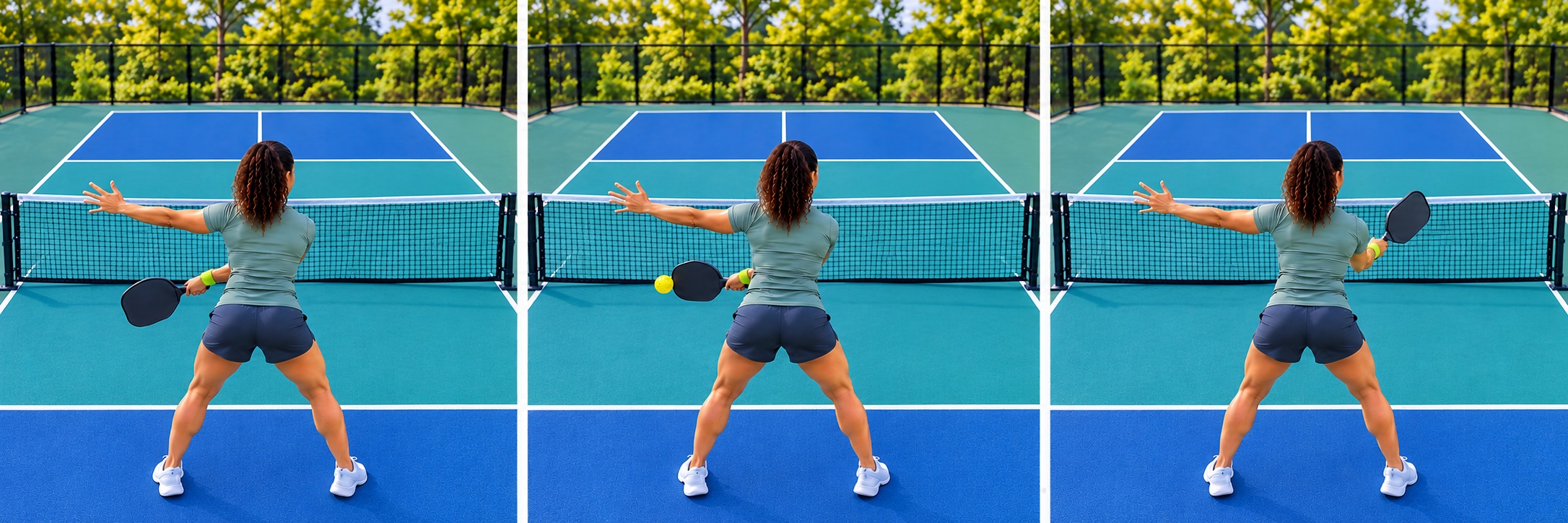
AI-generated movement study showing a fictional player from behind, facing the net. The lime band identifies the same right paddle wrist in every frame. Two-handed backhands add the bare left hand above the right on the handle. Use the written steps for technique and official rules for legality. Left-handed players reverse side-specific cues where appropriate.
Position, contact, recovery.
Where the movement starts
Use a legal position behind the kitchen line and choose a ball that allows a compact backhand attack. The same court boundaries apply to the preparation, contact and follow-through. Keep your partner ready for the reply.
Read the contact
The right arm crosses to the player’s left for a backhand; the bare left hand does not take over. Accelerate with a short coordinated upward-and-forward action, then recover. The posed free arm makes hand identity visible rather than prescribing one exact balance position.
Check it with a partner
Begin with a predictable comfortable feed, then add a low ball that should be dinked or reset. If you can only flick by taking a huge swing or falling forward, reduce the task and work on the contact window with a coach.
Official court dimensions ↗Three rounds to build the skill.
Begin with the first round. Spend your practice block there if it is still challenging; completing all three is optional. Swap hitter and feeder roles after short sets and exclude unsuitable feeds from the attempt count.
- 01
Set the backhand side
Play ten gentle backhand contacts from a compact preparation. Keep the paddle on the backhand side and meet the ball in front. Do not add acceleration until the feed feels manageable.
- 02
Add a short acceleration
On ten suitable feeds, use a coordinated upward-and-forward action and recover. The feeder blocks the ball rather than trying to win. Count placements that leave the hitter balanced.
- 03
Dink or flick
Mix suitable balls with low awkward ones. Choose a dink or reset when the attack would require a huge swing or forward fall. Have the feeder confirm whether the choice matched the contact window.
Record the task you actually did.
Separate a wrong-side or cramped contact from a target miss. If the only successful flicks depend on a long backswing, reduce the task before adding speed.
For the linked Matchday drill, count: controlled flick volleys reaching the target with recovery. Save actual attempts, successes and minutes, then name the round, feed, target and variation in your notes. For decision-only or shadow work, leave attempt counts blank rather than inventing target hits.
Log completed practice in Matchday ↗Sign in to save. Existing Free and Pro practice-log allowances apply; reading and training remain free.Make the challenge fit.
Start easier: Return to a compact backhand punch until the contact is repeatable.
Build the task: Continue the point against a live counter.
Keep the target definition fixed when comparing sets. Original practice design from BracketReady, with technique context in Introduce the backhand flick carefully and USA Pickleball · backhand flick volley ↗. Use the current official rules ↗ for legality.