Learn stacking without losing the correct server
Rehearse preferred-side movement, legal starting responsibilities and an organised return position.
Understand the job.
Stacking is a positioning tactic that helps a pair reach preferred sides after the serve or return. It does not change the correct server, receiver or service court. Learn the score and movement pattern at walking pace before using it in a match.
Movement and recovery study
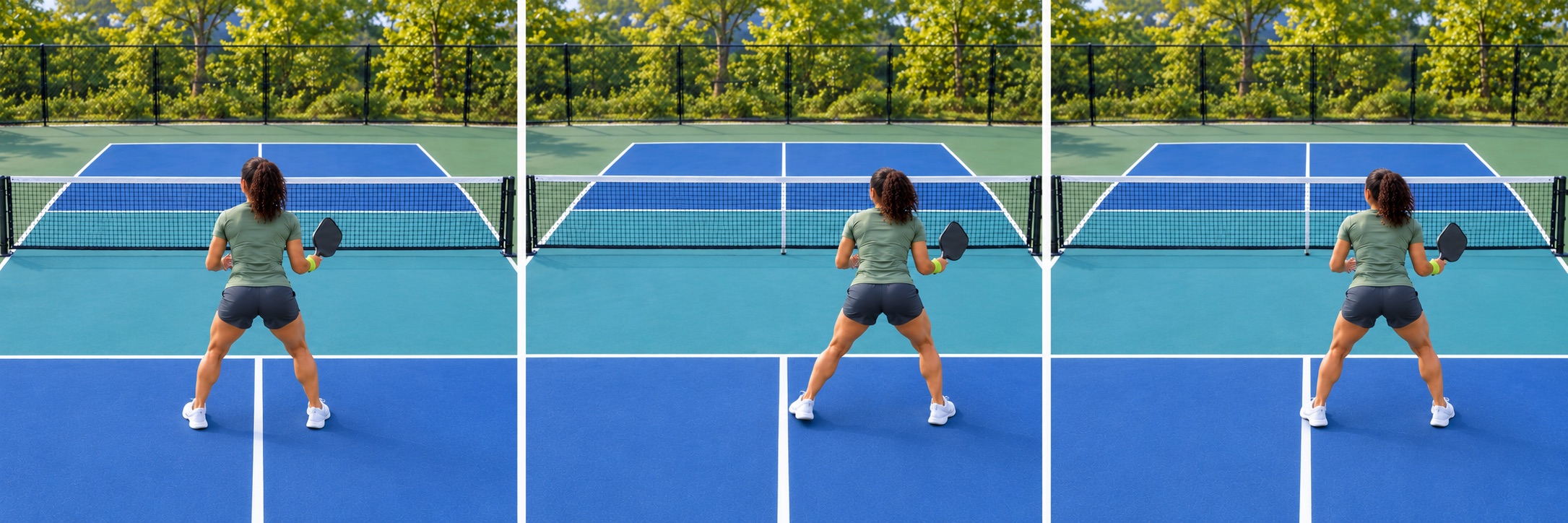
AI-generated movement study showing a fictional player from behind, facing the net. The lime band identifies the same right paddle wrist in every frame. Two-handed backhands add the bare left hand above the right on the handle. Use the written steps for technique and official rules for legality. Left-handed players reverse side-specific cues where appropriate.
Position, contact, recovery.
Where the movement starts
Organise movement relative to the net and your partner. At the kitchen line, travel sideways behind the line rather than drifting into it during a volley. At the baseline, recover towards the likely reply rather than always returning to an identical footprint.
Read the contact
Use small adjustment steps near the ball, but turn and travel naturally for longer distances. Settle your weight as the opponent contacts the ball; a split step is a modest readiness action, not a high jump.
Check it with a partner
Have the feeder wait until you recover before starting again. Then shorten that pause. Count balanced arrivals separately from successful shots so a lucky return does not hide a movement problem.
Official court dimensions ↗Step by step.
- 01
Choose why you are stacking
Agree the preferred sides and what benefit you expect. Consider both players’ comfort rather than assuming the stronger player must always take one side.
- 02
Rehearse the legal opening
Identify the correct server, receiver and service court at a stated score. Position the other partner without obstructing play, then walk the agreed movement after the serve or return.
- 03
Check before the next point
Reset the score, correct server and receiver before each rehearsal. If the pair becomes confused in a game, simplify the formation and use the applicable clarification procedure.
When it goes wrong.
Switching sides but forgetting service order
Say the correct server and receiver aloud during practice.
Using stacking before both players know the route
Walk the formation first, then add a gentle ball.
Stacking score-and-route rehearsal
A suggested BracketReady practice task. The counts are your observations, not a skill-rating test.
Set it up
A doubles pair, a court and a written list of 12 traditional doubles scores.
Do the work
For each scenario, identify correct server and receiver, then rehearse one legal opening and preferred-side recovery. Count complete accurate sequences.
Count this
Scenarios with correct service responsibilities and agreed movement. Record attempts and target hits using the same definition throughout.
Log this practice in Matchday ↗Sign in to save. Existing practice-log allowances apply. Log sessions you actually completed.Make it fit your level.
Practise only your serving-side formation first.
Mix serving and receiving scenarios at different scores.
Add a live return and third shot.
Know what you are reading.
Original BracketReady explanation and practice design from the BracketReady learning desk, with the technique reference below. For individual technique feedback, work with a qualified coach.
Photo sequences use a consistent fictional player, wardrobe, equipment and court. Some guides share a relevant movement study; the written lesson explains the specific variation.
References checked 23 October 2026. Event rules and official updates take precedence.
Your next useful read.
Move as a doubles team, not two separate players
Connect serve, return, transition and kitchen coverage with your partner’s actual position.
Agree who takes the middle before it matters
Replace last-second guessing with clear partnership calls and a plan for different contact positions.
Build a singles point around depth and recovery
Connect serve, return, passing lanes and a recovery position that follows the ball.