Add serve depth before adding more speed
Use generous depth targets, controlled pace and a return-based observation to develop your serve.
Understand the job.
A deeper serve can make the first return less comfortable, but depth is useful only if the serve stays legal and lands in. Judge the pattern against actual returns rather than assuming that a harder ball automatically helps.
Volley-serve movement study
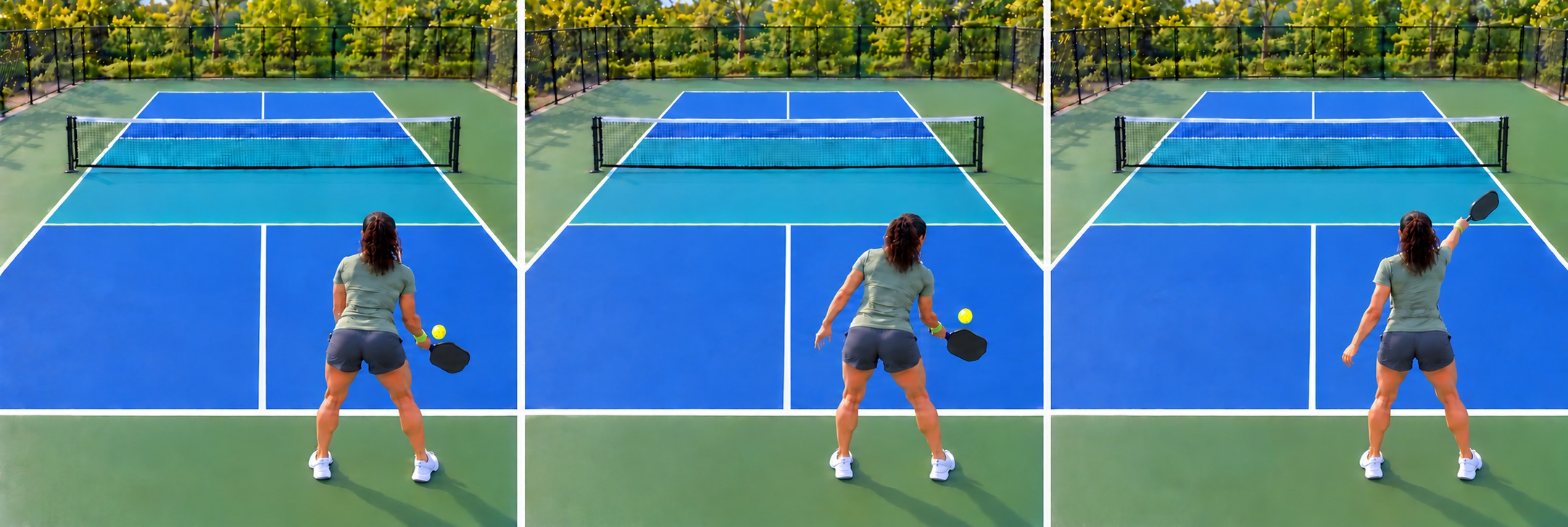
AI-generated movement study showing a fictional player from behind, facing the net. The lime band identifies the same right paddle wrist in every frame. Two-handed backhands add the bare left hand above the right on the handle. Use the written steps for technique and official rules for legality. Left-handed players reverse side-specific cues where appropriate.
Position, contact, recovery.
Where the movement starts
Start behind the baseline, between the imaginary extensions of the centreline and sideline. The diagonal service box is the target. The kitchen and its line are short of the legal service landing area; leave a generous margin beyond them.
Read the contact
For a volley serve, meet the released ball below the waist with an upward arm motion and paddle head below the wrist at contact. Keep the paddle in your dominant hand throughout; the other hand releases the ball.
Check it with a partner
Have a partner observe from the side for contact height and from behind for foot position. These photographs show the general motion, not a service-legality measurement. After serving, stay back long enough to let the return bounce.
Official court dimensions ↗Step by step.
- 01
Mark a realistic depth zone
Choose the back portion of the diagonal service box while leaving a useful buffer inside every line. A small strip on the baseline is a test of precision, not a beginner target.
- 02
Change one variable
Start with the legal serve you already use. Adjust the arc or swing through the target gently. Keep the release stable and observe whether the ball travels deeper without spraying wide.
- 03
Read the return
After serving, watch where the receiver contacts the ball and where the return lands. A deep serve is one part of a point, not proof that a particular opponent has a weak return.
When it goes wrong.
Lowering the margin to gain speed
Keep enough net clearance and reduce effort when misses climb.
Only counting aces
Record depth and return quality separately; many useful serves come back.
Depth without the extra effort
A suggested BracketReady practice task. The counts are your observations, not a skill-rating test.
Set it up
Mark a generous deep zone in each service box with flat safe markers.
Do the work
Hit three sets of 10 serves at the same comfortable effort. Count legal deep-target hits. With a receiver, note whether you still have time to prepare for the return.
Count this
Legal serves landing in the generous deep zone. Record attempts and target hits using the same definition throughout.
Log this practice in Matchday ↗Sign in to save. Existing practice-log allowances apply. Log sessions you actually completed.Make it fit your level.
Make the depth zone larger and use less pace.
Ask a receiver to return normally and rehearse the third shot.
Alternate deep-middle and deep-wide zones while keeping a line buffer.
Know what you are reading.
Original BracketReady explanation and practice design from the BracketReady learning desk, with the technique reference below. For individual technique feedback, work with a qualified coach.
Photo sequences use a consistent fictional player, wardrobe, equipment and court. Some guides share a relevant movement study; the written lesson explains the specific variation.
References checked 23 October 2026. Event rules and official updates take precedence.
Your next useful read.
Build a repeatable underhand volley serve
Learn a simple legal volley-serve routine, comfortable contact and generous diagonal targets.
Use a drop serve without complicating the release
Practise the bounce-based serving option, legal release and contact timing with a repeatable routine.
Return deep, then arrive ready
Use a compact return, a safe depth target and controlled movement towards your next court position.