Learn when to let a fast ball go
Practise judging pace and trajectory without turning the decision into a rigid shoulder-height rule.
Understand the job.
Leaving an out ball can win an exchange without a swing. Its flight depends on contact position, speed, spin, wind and your own position. “Shoulder high, let it fly” is a cue some players use, not a law that predicts every landing.
Ready-position movement study
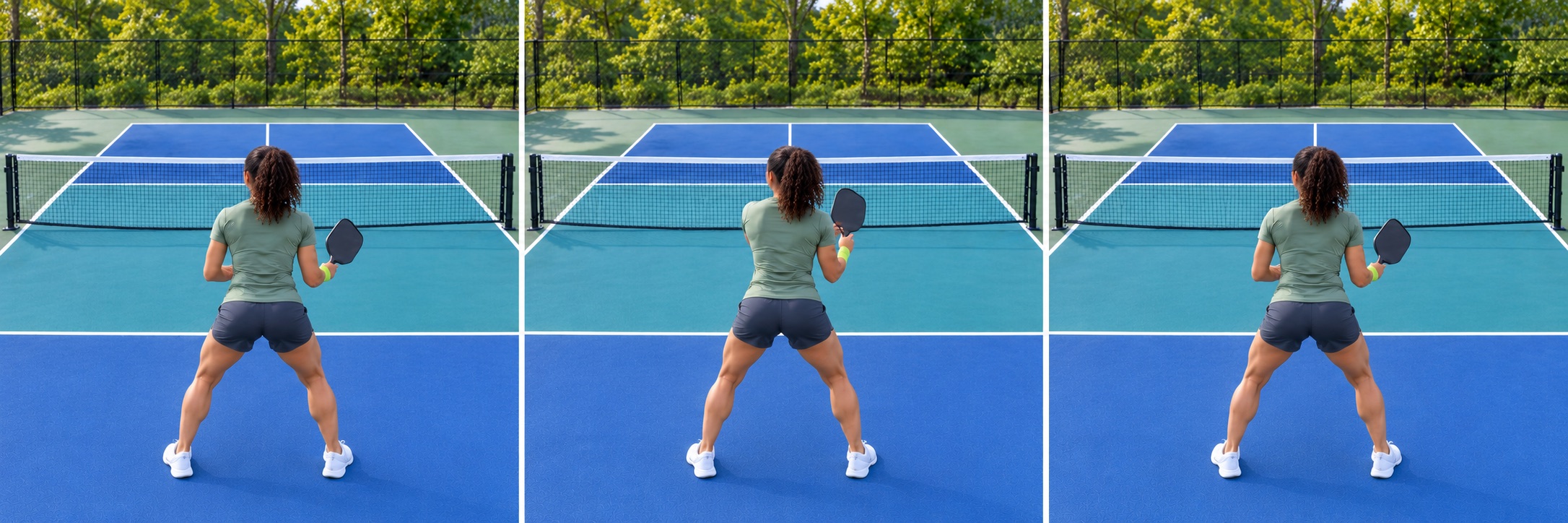
AI-generated movement study showing a fictional player from behind, facing the net. The lime band identifies the same right paddle wrist in every frame. Two-handed backhands add the bare left hand above the right on the handle. Use the written steps for technique and official rules for legality. Left-handed players reverse side-specific cues where appropriate.
Position, contact, recovery.
Where the movement starts
Face the net with room to move either way. At the kitchen, leave your shoes clear of the non-volley-zone line. A ready stance at the baseline can be lower and wider; do not copy one fixed paddle height for every situation.
Read the contact
Keep the paddle in the same dominant hand. A light touch from the other hand may support preparation without changing which hand grips the handle. Start with a comfortable handshake hold, then use gentle feeds to test both sides.
Check it with a partner
Ask a partner to alternate sides without warning. If you first have to untuck the paddle or uncross your feet, adjust your starting position. Readiness is the ability to respond, rather than a pose held for a photograph.
Official court dimensions ↗Step by step.
- 01
Start with observation
Watch a partner’s manageable feeds land without hitting them. Notice the flight from different contact heights and distances. Do not assume every high ball will finish long.
- 02
Make the choice early enough
If you intend to leave the ball, keep the paddle out of its path. Move only within a safe comfortable range and avoid turning away before you know its direction.
- 03
Review the actual landing
Use the observed bounce as feedback. Keep your line calls honest and follow the applicable rules when you cannot clearly see a ball out.
When it goes wrong.
Using shoulder height as the only signal
Add pace, spin and contact distance to your judgement.
Swinging halfway, then stopping late
Practise an early clear choice at a manageable feed speed.
Play or leave judgement set
A suggested BracketReady practice task. The counts are your observations, not a skill-rating test.
Set it up
A partner gives 20 varied but comfortable feeds; clear the space behind you.
Do the work
Call “play” or “leave” before contact. When leaving, observe the landing. Count choices confirmed by the actual landing or an in-court return.
Count this
Play-or-leave decisions confirmed by the observed ball. Record attempts and target hits using the same definition throughout.
Log this practice in Matchday ↗Sign in to save. Existing practice-log allowances apply. Log sessions you actually completed.Make it fit your level.
Observe feeds without playing any of them.
Mix these decisions into cooperative kitchen exchanges.
Vary the feeder’s distance before adding more speed.
Know what you are reading.
Original BracketReady explanation and practice design from the BracketReady learning desk, with the technique reference below. For individual technique feedback, work with a qualified coach.
Photo sequences use a consistent fictional player, wardrobe, equipment and court. Some guides share a relevant movement study; the written lesson explains the specific variation.
References checked 23 October 2026. Event rules and official updates take precedence.
Your next useful read.
Block a fast ball with a quieter paddle
Absorb a manageable drive, reduce the backswing and guide a defensive volley into the kitchen.
Use a compact punch volley with a clear target
Redirect a comfortable higher ball with a short forward action and quick paddle recovery.
Make the forehand volley compact and reliable
Meet a comfortable forehand ball in front, choose block or punch and recover outside the kitchen.