ATP and Erne: recognise the opportunity and the rules
Understand advanced around-the-post and outside-the-kitchen options before adding speed or a jump.
Understand the job.
An ATP sends a wide ball around the net post. An Erne is a volley made from outside the sideline beside the kitchen. They are advanced options, not shots every player needs. The movement photos illustrate balance and preparation, not the full ATP or Erne route.
Movement and recovery study
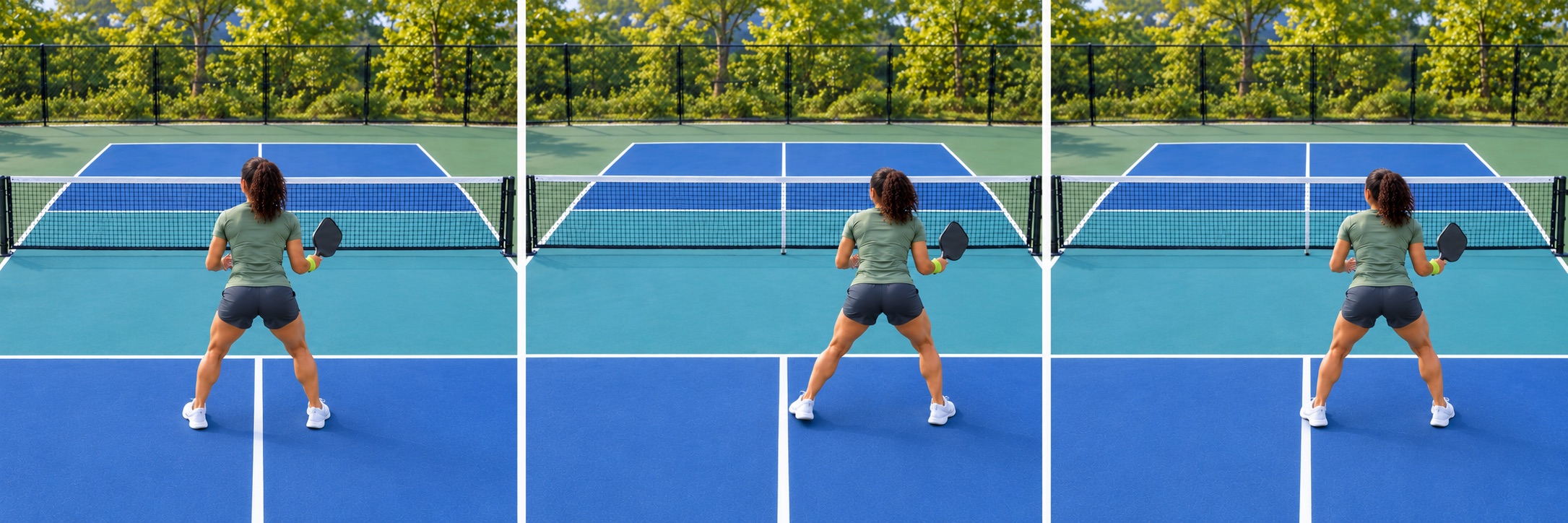
AI-generated movement study showing a fictional player from behind, facing the net. The lime band identifies the same right paddle wrist in every frame. Two-handed backhands add the bare left hand above the right on the handle. Use the written steps for technique and official rules for legality. Left-handed players reverse side-specific cues where appropriate.
Position, contact, recovery.
Where the movement starts
Organise movement relative to the net and your partner. At the kitchen line, travel sideways behind the line rather than drifting into it during a volley. At the baseline, recover towards the likely reply rather than always returning to an identical footprint.
Read the contact
Use small adjustment steps near the ball, but turn and travel naturally for longer distances. Settle your weight as the opponent contacts the ball; a split step is a modest readiness action, not a high jump.
Check it with a partner
Have the feeder wait until you recover before starting again. Then shorten that pause. Count balanced arrivals separately from successful shots so a lucky return does not hide a movement problem.
Official court dimensions ↗Step by step.
- 01
Recognise a genuine ATP opening
A sufficiently wide bounce may create a path around the post into the opponent’s court; that path need not pass above net height. Check the available run-off space and avoid contacting the net or its support. Do not chase an unsafe route.
- 02
Learn a grounded Erne route
Walk around the outside of the kitchen to the area beyond the sideline, keeping clear of the net. If you entered the kitchen, re-establish both feet outside before any volley. A jump is not required to learn the concept.
- 03
Check the complete legal sequence
Keep volley take-off, contact and momentum clear of the kitchen and its lines. Avoid net contact, opponent interference and crossing the net plane illegally. Review the current rulebook with a qualified coach or referee before live attempts.
When it goes wrong.
Assuming the sideline makes every volley legal
Kitchen re-establishment, momentum and net-plane rules still matter.
Practising a jump before learning the route
Use a slow grounded rehearsal with clear space first.
Advanced route recognition
A suggested BracketReady practice task. The counts are your observations, not a skill-rating test.
Set it up
A clear court and a partner; begin without a live ball.
Do the work
Walk through 12 ATP-or-Erne scenarios. Name the opportunity, legal route and recovery. Count only scenarios where you can explain all three; add gentle feeds only when the route is comfortable.
Count this
Scenarios with a correctly identified opportunity, legal route and recovery. Record attempts and target hits using the same definition throughout.
Log this practice in Matchday ↗Sign in to save. Existing practice-log allowances apply. Log sessions you actually completed.Make it fit your level.
Study the court positions and current rules without attempting a shot.
Use a gentle wide feed with a partner covering the court.
Ask a coach or referee to check a slow full sequence before increasing speed.
Know what you are reading.
Original BracketReady explanation and practice design from the BracketReady learning desk, with the technique reference below. For individual technique feedback, work with a qualified coach.
Photo sequences use a consistent fictional player, wardrobe, equipment and court. Some guides share a relevant movement study; the written lesson explains the specific variation.
References checked 23 October 2026. Event rules and official updates take precedence.
Your next useful read.
Move as a doubles team, not two separate players
Connect serve, return, transition and kitchen coverage with your partner’s actual position.
Agree who takes the middle before it matters
Replace last-second guessing with clear partnership calls and a plan for different contact positions.
Learn stacking without losing the correct server
Rehearse preferred-side movement, legal starting responsibilities and an organised return position.