Adjust to wind without rebuilding your strokes
Observe flight on both ends, widen targets and make one practical change at a time.
Understand the job.
Wind changes the ball’s flight and may vary during the same match. Make observations on each end instead of relying on a fixed formula. Keep line margins generous and avoid changing technique after every unusual bounce.
Volley-serve movement study
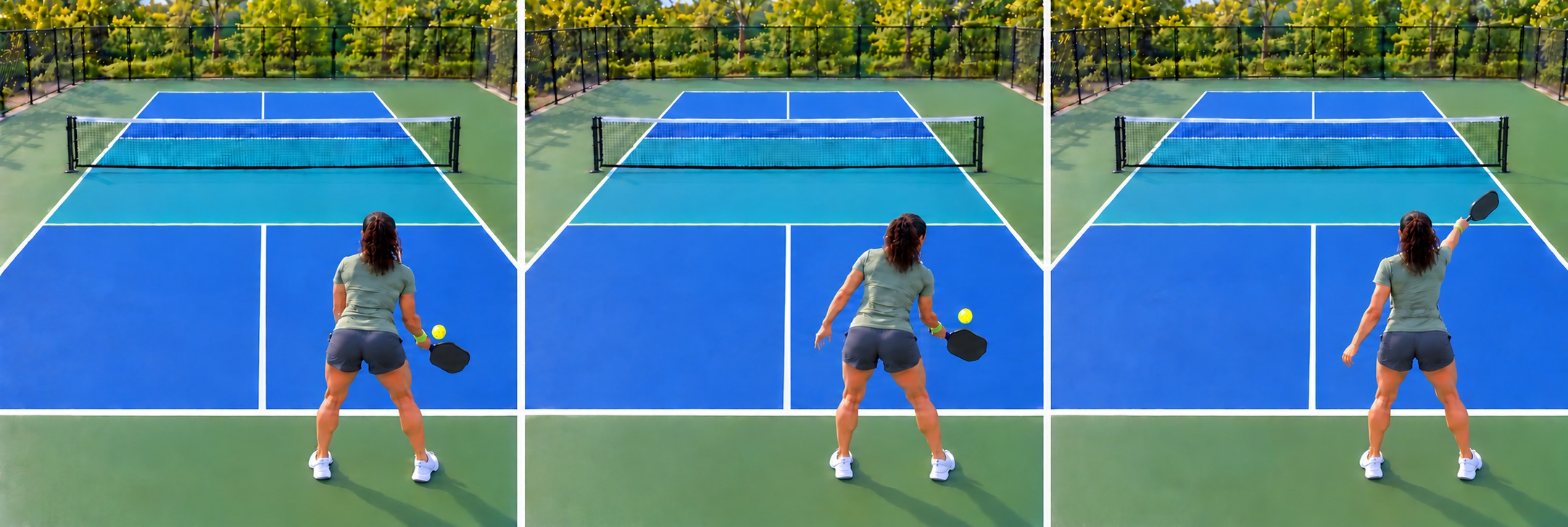
AI-generated movement study showing a fictional player from behind, facing the net. The lime band identifies the same right paddle wrist in every frame. Two-handed backhands add the bare left hand above the right on the handle. Use the written steps for technique and official rules for legality. Left-handed players reverse side-specific cues where appropriate.
Position, contact, recovery.
Where the movement starts
Start behind the baseline, between the imaginary extensions of the centreline and sideline. The diagonal service box is the target. The kitchen and its line are short of the legal service landing area; leave a generous margin beyond them.
Read the contact
For a volley serve, meet the released ball below the waist with an upward arm motion and paddle head below the wrist at contact. Keep the paddle in your dominant hand throughout; the other hand releases the ball.
Check it with a partner
Have a partner observe from the side for contact height and from behind for foot position. These photographs show the general motion, not a service-legality measurement. After serving, stay back long enough to let the return bounce.
Official court dimensions ↗Step by step.
- 01
Observe before deciding
During warm-up, watch several serves, returns and high balls on both ends. Notice whether the ball carries long, holds up or drifts sideways. Recheck when the wind changes.
- 02
Change the target first
Move the aim farther inside the lines and use a trajectory you can control. Reduce a high-risk lob or sideline attempt if the conditions make its landing less predictable.
- 03
Keep notes specific
Describe the end, direction and actual miss. Try one adjustment and observe several balls before deciding whether it helped. Communicate the same observation to your partner.
When it goes wrong.
Assuming the same adjustment works on both ends
Reassess after changing ends.
Trying to overpower every headwind
Use controlled contact and a larger target before adding effort.
Two-end flight check
A suggested BracketReady practice task. The counts are your observations, not a skill-rating test.
Set it up
A court in playable conditions and a partner; stop if conditions are unsafe.
Do the work
Hit 10 controlled serves from each end into a broad target. Count legal target hits and note the flight difference. Use the same effort before making one adjustment.
Count this
Legal serves reaching the wind-adjusted broad target. Record attempts and target hits using the same definition throughout.
Log this practice in Matchday ↗Sign in to save. Existing practice-log allowances apply. Log sessions you actually completed.Make it fit your level.
Use the whole legal box and moderate pace.
Play opening sequences while changing ends normally.
Repeat with cooperative returns and compare the two ends.
Know what you are reading.
Original BracketReady explanation and practice design from the BracketReady learning desk, with the technique reference below. For individual technique feedback, work with a qualified coach.
Photo sequences use a consistent fictional player, wardrobe, equipment and court. Some guides share a relevant movement study; the written lesson explains the specific variation.
References checked 23 October 2026. Event rules and official updates take precedence.
Your next useful read.
Move as a doubles team, not two separate players
Connect serve, return, transition and kitchen coverage with your partner’s actual position.
Agree who takes the middle before it matters
Replace last-second guessing with clear partnership calls and a plan for different contact positions.
Learn stacking without losing the correct server
Rehearse preferred-side movement, legal starting responsibilities and an organised return position.