Use skinny singles as a purposeful practice game
Agree a half-court format and use constraints to rehearse placement, patience and recovery.
Understand the job.
Skinny singles uses part of the court for a one-on-one practice game. Clubs use different versions. Agree the playable half, service rules and scoring before starting so the exercise measures a skill rather than an argument about the format.
Forehand movement study
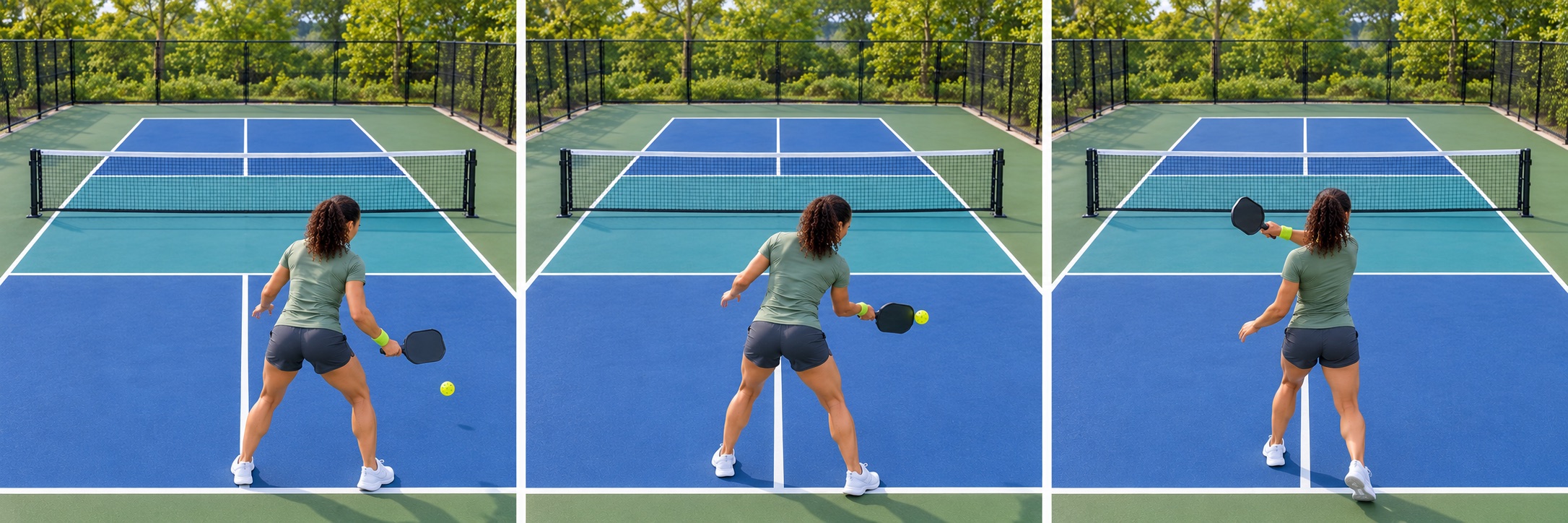
AI-generated movement study showing a fictional player from behind, facing the net. The lime band identifies the same right paddle wrist in every frame. Two-handed backhands add the bare left hand above the right on the handle. Use the written steps for technique and official rules for legality. Left-handed players reverse side-specific cues where appropriate.
Position, contact, recovery.
Where the movement starts
A baseline groundstroke is played after a bounce. Make space on your paddle-hand side, with the net and intended target ahead. You can turn your shoulders during preparation without turning the shot away from the playing court.
Read the contact
For the illustrated right-handed player, forehand contact is to her right and forward of her hip. The same right hand keeps the paddle through the finish across the body. Left-handed players reverse these side-specific cues.
Check it with a partner
Use an easy feed that gives time to organise the feet. If contact drifts behind your hip, reduce feed speed and prepare earlier. First judge comfortable spacing and a broad target; add pace only after those are repeatable.
Official court dimensions ↗Step by step.
- 01
Choose a clear format
Decide whether the playable area is straight or diagonal, how serving works, and what counts out. Use flat safe markers if a boundary is unclear.
- 02
Name one intention
Choose depth, a backhand return, patient dinking or the first soft transition ball. Keep the intention observable rather than using “play better”.
- 03
Review the constraint
After a short game, ask whether the small court encouraged the intended skill. Adjust the format if it simply rewards the same fast winner every point.
When it goes wrong.
Changing the boundaries mid-rally
Agree the local practice rules before serving.
Treating the result as full-court singles evidence
Record the format and compare like with like.
Skinny singles intention game
A suggested BracketReady practice task. The counts are your observations, not a skill-rating test.
Set it up
Two players and an agreed half-court practice format.
Do the work
Play 20 rally starts with one named intention. Count opportunities where you follow it and keep the result separate from official match records.
Count this
Rally opportunities where the chosen intention was followed. Record attempts and target hits using the same definition throughout.
Log this practice in Matchday ↗Sign in to save. Existing practice-log allowances apply. Log sessions you actually completed.Make it fit your level.
Begin cooperatively and use a larger shared target.
Start from a pressure score with normal local scoring.
Change one constraint, such as requiring a soft third before open play.
Know what you are reading.
Original BracketReady explanation and practice design from the BracketReady learning desk, with the technique reference below. For individual technique feedback, work with a qualified coach.
Photo sequences use a consistent fictional player, wardrobe, equipment and court. Some guides share a relevant movement study; the written lesson explains the specific variation.
References checked 23 October 2026. Event rules and official updates take precedence.
Your next useful read.
Warm up your strokes before testing your pace
Use a gradual ball-based routine, a court check and a shared intention before your first game.
Make wall practice transfer to a real court
Use safe spacing, a visible target and repeatable solo drills for control and recovery.
Build a practice plan you can actually measure
Choose one skill, set an observable task and connect practice to your next Matchday reflection.